 Preston Cecilian Choral Society began in 1927 when Alice Livesey, a multi-talented musician from Ashton-on-Ribble, formed a ladies' choir to compete in local festivals. Two years later, after many successes, she added male voices to give the choir greater scope. By May 1930, records show that 17 men had been recruited. In October that year, the choir's name was changed to Preston Cecilian Choir. Concerts, previously held in local church halls, moved to the Guild Hall, and the choir now numbered 70. The Hesketh Bank Singers joined for its first performance of Handel's Messiah on December 29th, 1932, at the Public Hall, with a young Isobel Baillie as the soprano soloist. This oratorio featured regularly, if not annually, in the years before the war began in 1939.
After the outbreak of war, the choir kept functioning, with all concerts transferred back to the Guild Hall because the Army had requisitioned the Public Hall for the Royal Army Pay Corps. Large scale works during this period included Mendelssohn's Elijah, Haydn's Creation, Offenbach's The Tales of Hoffman, Edward German's Tom Jones, Coleridge-Taylor's Hiawatha, and a popular concert version of Carmen. Many famous singers visited Preston during this time, including Elena Danieli, Heddle Nash, Lilian Cooper, Jan Van De Gucht, Edward Reach, and Owen Brannigan, who had one of his first professional engagements with the society and returned on multiple occasions.
Merrie England was chosen again for the 21st anniversary concert in 1948, with an audience of 2,300 helping the society celebrate its coming of age. The next milestone was the celebration of Preston Guild in September 1952, memorable for the first performance of A Song for St Cecilia's Day by John Robinson, the blind Preston musician and teacher.
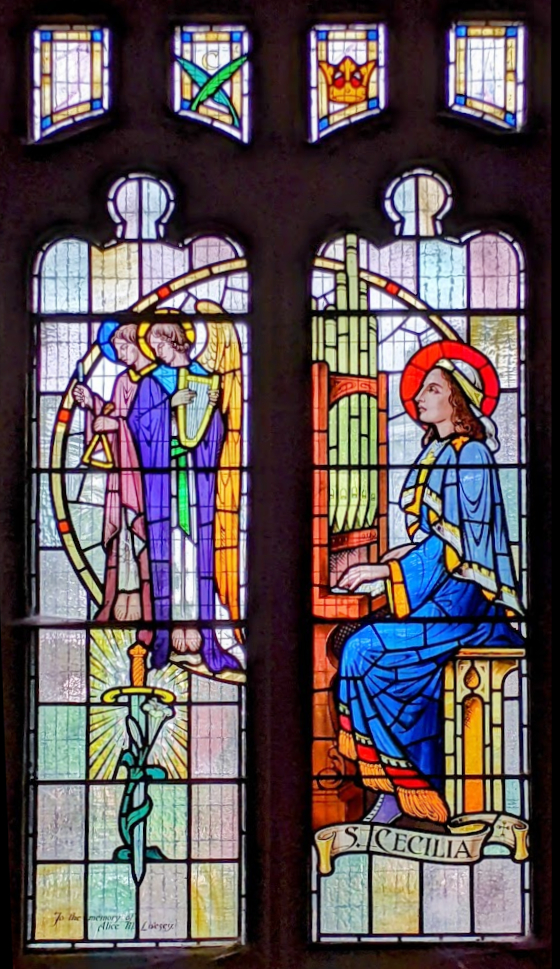 The first sign of Miss Livesey's ill health appeared when Horatio Waywell, deputy conductor of Preston Symphony Orchestra, shared the conductor's rostrum for Messiah in December 1956. This was the last time she conducted the choir, her main interest for almost 30 years. Miss Livesey is remembered in a stained-glass window (right) depicting St Cecilia in St Michael's Church, Ashton-on-Ribble, where Miss Livesey was organist for many years. You can read more about Miss Livesey here.
After Miss Livesey's death, Horatio Waywell led the choir until October 1964, when Robert Hull was appointed conductor. He had joined the choir as a baritone in 1962 and, at 26, brought youth, energy, and a fresh approach to the ensemble.
From September 1988, David Wroe was Musical Director and conducted Orff's Carmina Burana in 1989. He was succeeded later that year by Andrew Barrett, and in 1993 by Peter Heron, who conducted Bruckner Motets and Mendelssohn’s St Paul. Michael Ward took over in 1994 for two years, introducing the choir to works including Barber's Agnus Dei. In 1996, Graham Jackson, the choir’s accompanist since 1968, became Musical Director and often conducted from the keyboard.
Graham Jackson remained in post for six years until Chris Gill, a 27-year-old, was appointed in January 2003. Under his baton, the choir explored less familiar territory, such as Vierne's Mass for choir and two organs and the unaccompanied works Britten's Hymn to St Cecilia and Grieg's Four Psalms.
In 2010 the society appointed Marco Fanti, from Bologna. Marco brought his three UK choirs together in 2013 for a grand performance of Verdi's Requiem, ccompanied by the Lancashire Sinfonietta. In 2014, Robert Brooks became the conductor, leading the choir through the challenging two years of the COVID-19 pandemic. Marc Murray was appointed in September 2022.
There's more detail on our Performance History page and our page about our founder, Alice Livesey.